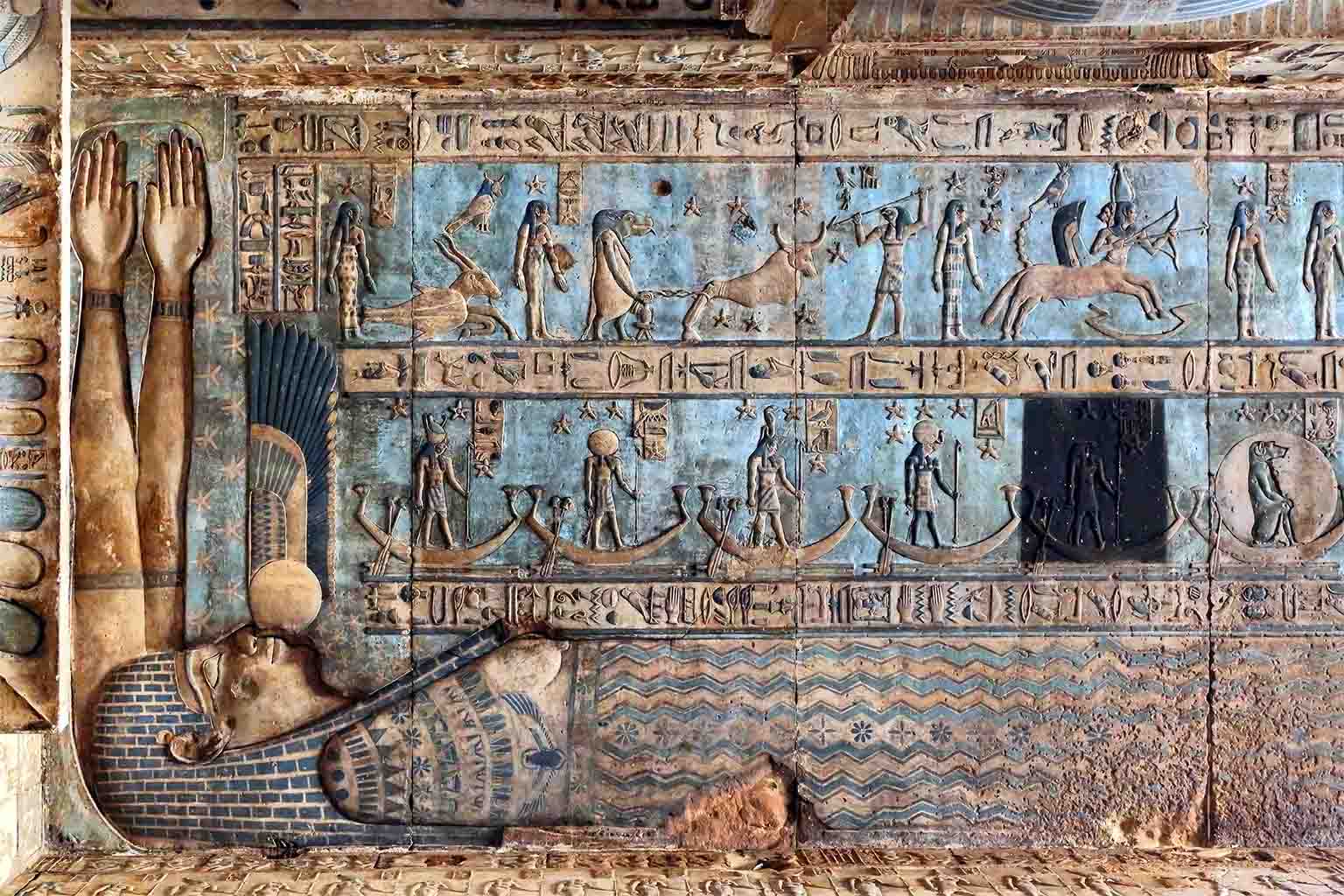
The ancient civilization of Egypt has always intrigued historians and scientists with its deep connection to the cosmos. Recent studies have unveiled a remarkable link between Egyptian mythology and the understanding of the Milky Way, shedding new light on the ancient perspective of the universe. Dr. Or Graur, an Associate Professor of Astrophysics at the University of Portsmouth, has conducted a pivotal research study focusing on the sky goddess Nut, showcasing her significance in both mythology and ancient astronomical beliefs.
Nut, often depicted as a goddess extending across the sky, is central to Egyptian cosmology. Dr. Graur's research, published in the Journal of Astronomical History and Heritage, analyzes over 125 ancient images of Nut found on well-preserved coffins, suggesting that the stars portrayed on her body may represent the Milky Way galaxy. This interpretation suggests that ancient Egyptian artists envisioned the glowing band of stars not merely as a decorative element but as a cosmic representation intertwined with religious significance.
The Milky Way, as it appears in winter, seems to outline Nut's arms, while in the summer, it traces her spine. Dr. Graur emphasizes that Nut should not be seen as a direct representation of the Milky Way itself but rather as a divine figure adorned with celestial bodies that symbolize protection over Earth. This distinction highlights the intricacy of Egyptian cosmology, where mythology and astronomy beautifully converge.
Dr. Graur’s research illustrates how the ancient Egyptians interpreted their night sky through a blend of empirical observations and spiritual beliefs. This reflects a broader trend among early civilizations, who often sought to understand and explain natural phenomena through the lens of their cultural narratives. By integrating astrophysical analysis with archaeological insights, Dr. Graur’s work provides a unique perspective on how ancient societies viewed their place in the universe.
The implications of these findings extend beyond the realm of mythology; they underscore an essential principle that resonates even today—human curiosity about the cosmos remains a timeless pursuit. The connection between Nut and the Milky Way serves as a poignant reminder of humanity’s quest for meaning in the universe, a curiosity that persists despite advancements in technology and understanding.
In 2024 and into the future, Dr. Graur's conclusions inspire a reconsideration of ancient artistic expressions as not merely decorative but rather profound narratives reflecting the sophistication of ancient peoples' understanding of the universe. The ancient Egyptians, despite lacking modern astronomical tools, possessed a rich and contemplative perspective on the cosmos that can still offer valuable insights today.
Dr. Graur's research invites scholars and enthusiasts alike to delve into the intricate relationship between art and astronomy, prompting new discussions about how ancient cultures, including Egypt, comprehended the celestial wonders that adorned their skies. As we explore these cosmic connections, we honor our ancestors' enduring fascination with the stars, which continues to resonate within us today.