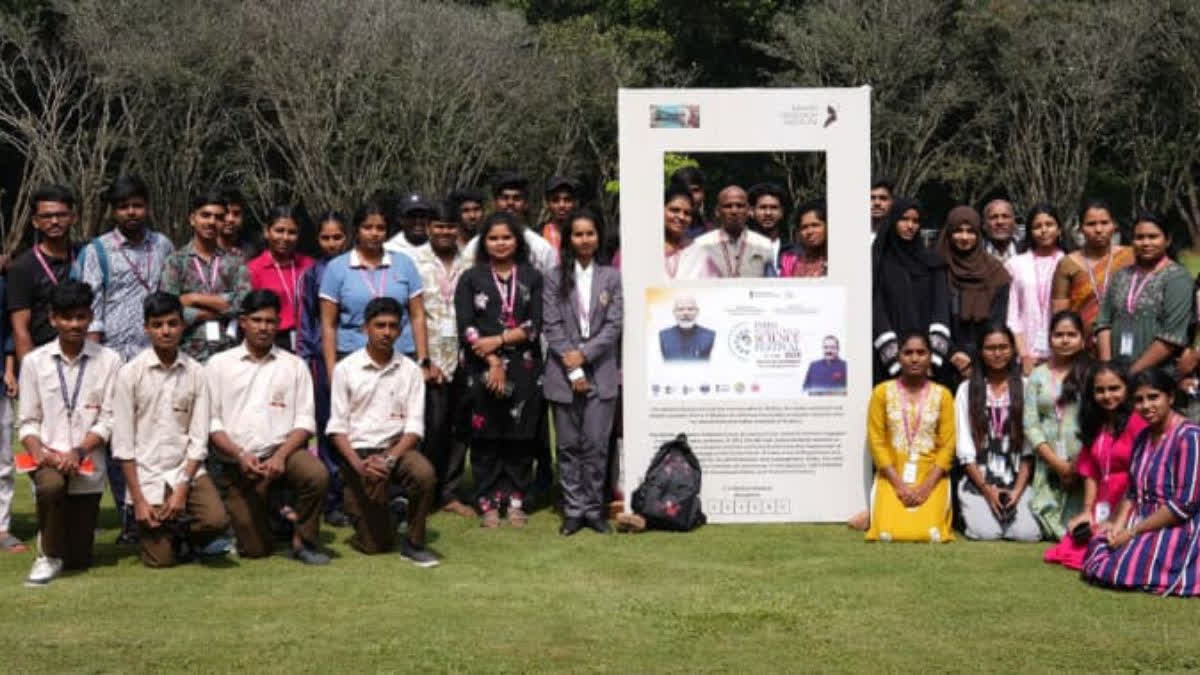
The Raman Research Institute (RRI) in Bengaluru recently hosted a curtain raiser event to promote the upcoming India International Science Festival (IISF) 2025. This initiative aims to foster a deeper understanding of scientific principles and stimulate interest among science lovers. The event showcased a series of enlightening talks that focused on pivotal topics such as Astronomy and Astrophysics, as well as quantum technology, reflecting the ongoing efforts to integrate science into community engagement.
Prof. Mayuri S Rao, a renowned figure in Astronomy and Astrophysics, opened the event with an insightful discussion regarding the electromagnetic spectrum's role in understanding the early universe. She highlighted the PRATUSH space payload, which aims to detect subtle radio signals from hydrogen atoms. This project is expected to unveil significant details concerning the origins of the first stars formed in the universe, particularly from lunar orbit.
Further advancing the exploration of scientific boundaries, Prof. Urbasi Sinha presented her research from the Quantum Information & Computing (QuIC) laboratory at RRI. Her presentation focused on the use of single and entangled photons in establishing secure quantum communication protocols, specifically quantum key distribution (QKD). Prof. Sinha emphasized the increasing importance of quantum cryptography in an age where digital communications face numerous security challenges, thereby underlining RRI's goal of developing extensive quantum networks.
Additionally, Prof. Saptarishi Chaudhuri contributed insights into the research being conducted at RRI’s Quantum Mixtures (QuMix) lab. His discussion centers on ultra-cold Rydberg atoms and the innovative methods employed to cool and trap atomic clouds composed of varied species such as sodium and potassium. His team's scientific endeavors aim to investigate atomic spin correlations and precision spectroscopy, with broader implications for quantum simulation and advanced technology developments.
Scheduled for December 6-9, 2025, the IISF 2025 in Panchkula, Haryana, will present 14 thematic frontiers aimed at addressing future technologies, sustainability, and comprehensive scientific outreach. Its overarching theme is “Vigyan Se Samriddhi: For Aatmanirbhar Bharat,” intended to inspire a self-reliant India through scientific advancements.
Founded in 1948 by Nobel Laureate Professor C. V. Raman, the RRI is a leading research institution in India dedicated to pioneering fundamental research within select realms of physics. Through initiatives like these, RRI continues to promote the integration of science into community life, emphasizing the relevance and potential of scientific inquiry in shaping the future.