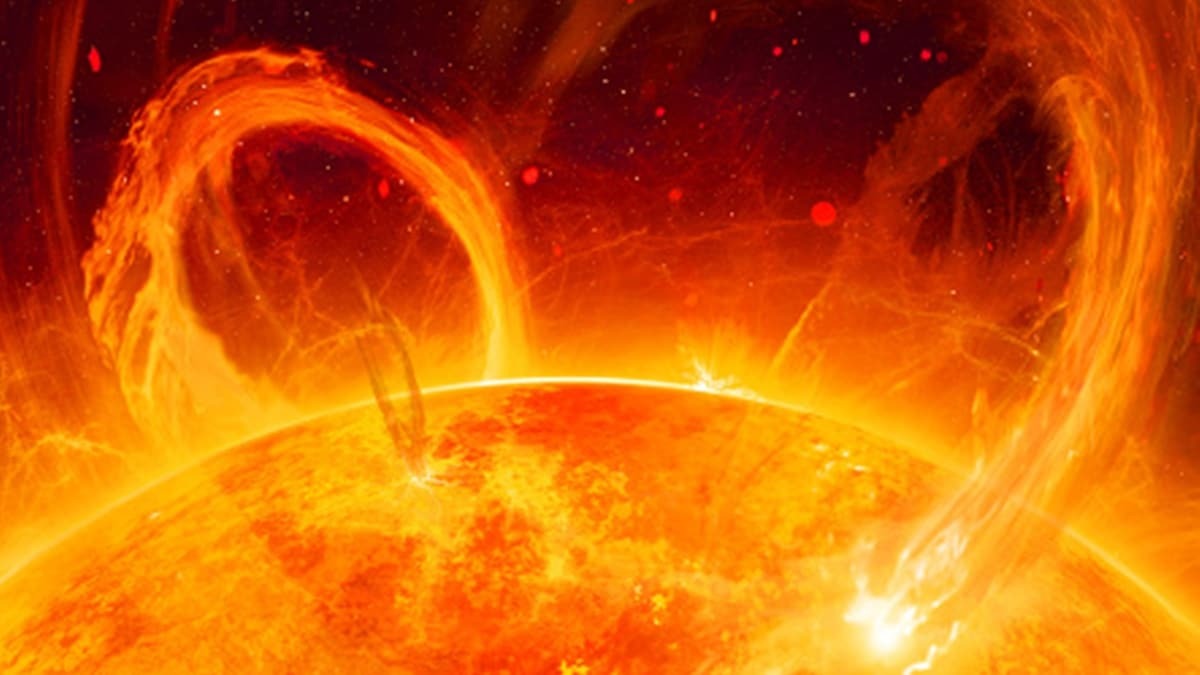
A significant geomagnetic storm has raised alarms globally, affecting satellites and power grids as Earth's atmosphere reacts to a powerful solar event. The disturbance was triggered by the early arrival of two coronal mass ejections (CMEs) on November 11, resulting in a G4-class solar storm that sent energetic particles crashing into the planet, producing stunning auroras visible as far south as Florida, Texas, and Alabama.
This solar activity escalated dramatically with a massive flare from sunspot 4274, which released a surge of highly energetic protons toward Earth, some penetrating deep into the atmosphere. Professor Clive Dyer of the Surrey Space Centre highlighted the significance of this phenomenon, noting an unusual spike in cosmic-ray activity detected by neutron monitors around the globe, indicating a Ground Level Event (GLE). Such GLEs are rare, typically occurring only once or twice during each solar cycle.
Dyer drew comparisons between the current event and the last notable GLE observed on December 13, 2006, describing it as a "20-year event". This previous event increased radiation exposure for passengers on high-latitude flights by up to 30 microSieverts per hour. Current analyses suggest that airborne radiation levels may have similarly surged, especially over polar regions, making today's GLE critical for future preparations against more severe solar outbursts. The infamous February 23, 1956 event amplified radiation at high altitudes by a remarkable factor of 1,000.
The ramifications of this storm extend beyond surface conditions on Earth. In space, energetic solar protons are bombarding satellite surfaces and imaging systems, presenting substantial risks to spacecraft operations and data integrity. Increasing instances of CMEs have kept forecasters at the US National Oceanic and Atmospheric Administration (NOAA) on high alert, as these geomagnetic storms pose threats to radio transmissions, GPS systems, and possibly air traffic control, particularly in polar regions.
While aurora enthusiasts in northern regions relish the display of vibrant northern lights, experts remind the public that these solar storms can have severe consequences. Intense solar winds and charged plasma can overload power grids with geomagnetically induced currents (GICs), potentially leading to blackouts. Historical events underscore this danger; the 1859 Carrington Event ignited telegraph systems, and a 1972 storm triggered the detonation of US sea mines near Vietnam.
Despite advancements in space weather forecasting, experts stress that precise long-term predictions remain challenging. Critical infrastructure and the public often receive minimal warning, typically just a few days, before a solar event reaches Earth. With the current solar cycle approaching its peak, ongoing vigilance and rapid response capabilities will be key to mitigating the impacts of such space phenomena.